Coastal engineering archive

Towers drawn against force.

Five lighthouse sites. Exposed rock. Heavy masonry. Glass optics. Distinct flashes. The record runs from repeated losses at Eddystone to automation across the waters managed by Trinity House, the Northern Lighthouse Board and the Commissioners of Irish Lights.

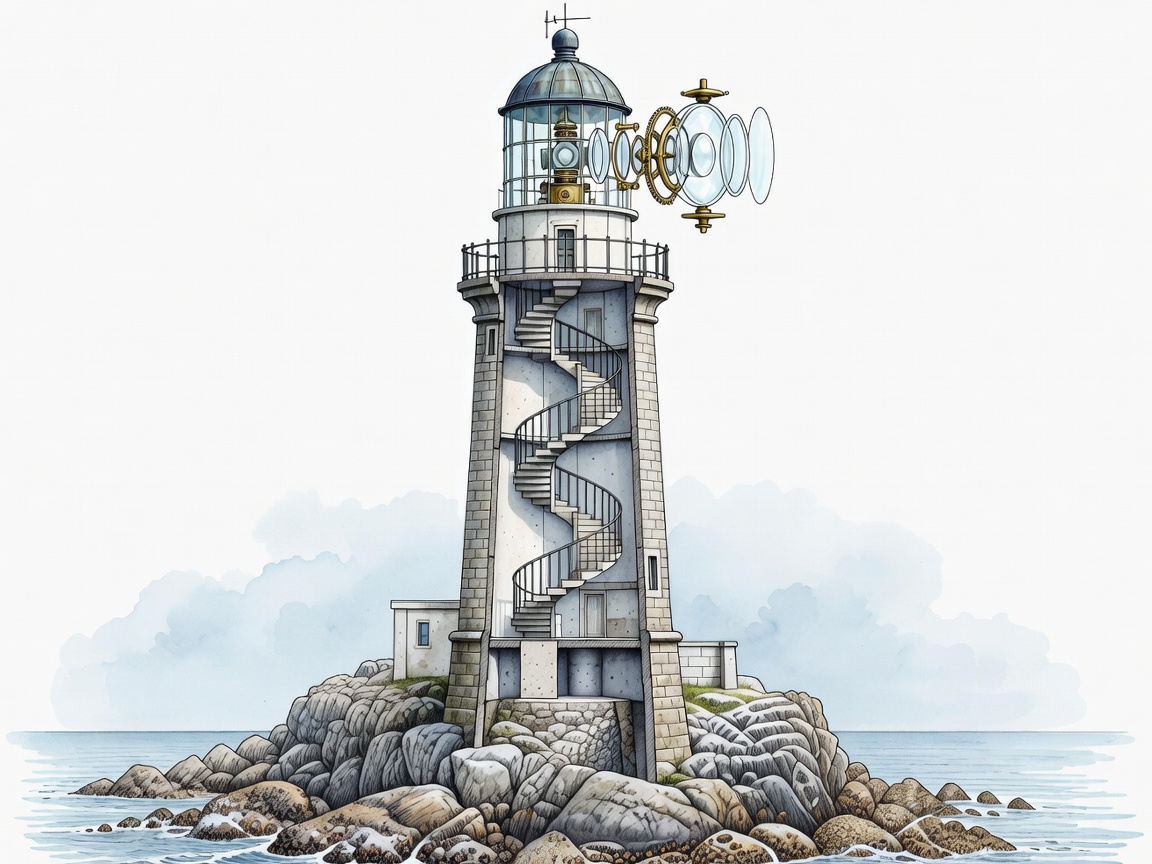
Technical illustration of a lighthouse tower, lantern optics and wave-cut rock foundation
PLATE 01TOWER / OPTIC / ROCK
Index line A–E

Five sites. Five engineering arguments.

Read the sequence as a set of responses to local rock, wave action and navigational need. Each tower inherits ideas from earlier work, but no site permits a simple repeat.

A

Eddystone: repeated towers, changing answers

Winstanley’s timber structure, Rudyard’s replacement, Smeaton’s interlocking masonry and Douglass’s later tower show design advancing through failure, observation and a better reading of the reef.

Inspect Eddystone
B

Bell Rock: building where the sea removes the site

Robert Stevenson’s masonry tower stands on a reef submerged for much of the tide. The guide follows the temporary beacon, shore base, dovetailed stone and Northern Lighthouse Board context.

Inspect Bell Rock
C

Skerryvore: mass, curve and Atlantic exposure

Alan Stevenson’s tower converts a low, wave-swept skerry into a foundation for carefully bonded granite. Its profile, logistics and optical equipment reward comparison with Bell Rock.

Inspect Skerryvore
D

Fastnet: granite at Ireland’s outer edge

Fastnet’s later masonry tower replaced a vulnerable iron structure. William Douglass’s design, James Kavanagh’s site work and the Commissioners of Irish Lights frame the account.

Inspect Fastnet
E

South Stack: an island station within reach

South Stack differs from the offshore rock towers. Access, cliff-top geography, Trinity House operation and automated equipment show how a station can remain dramatic yet technically routine.

Inspect South Stack
System layers

A lighthouse is more than its tower.

Stone receives the force. The lantern controls the beam. The flash pattern identifies the station. An authority maintains the aid to navigation and changes it as technology permits.

Structure

Foundation geometry matters first. Builders cut beds into sound rock, shaped masonry to resist sliding and used interlocking joints where lifting water could exploit an ordinary horizontal course.

Optical signal

Reflectors gave way to Fresnel lenses. Concentrating rings bend light without the mass of a solid lens. Rotation then turns a steady source into a recognisable sequence of flashes.

Administration

Trinity House covers England, Wales, the Channel Islands and Gibraltar. The Northern Lighthouse Board serves Scotland and the Isle of Man. The Commissioners of Irish Lights operates around Ireland.