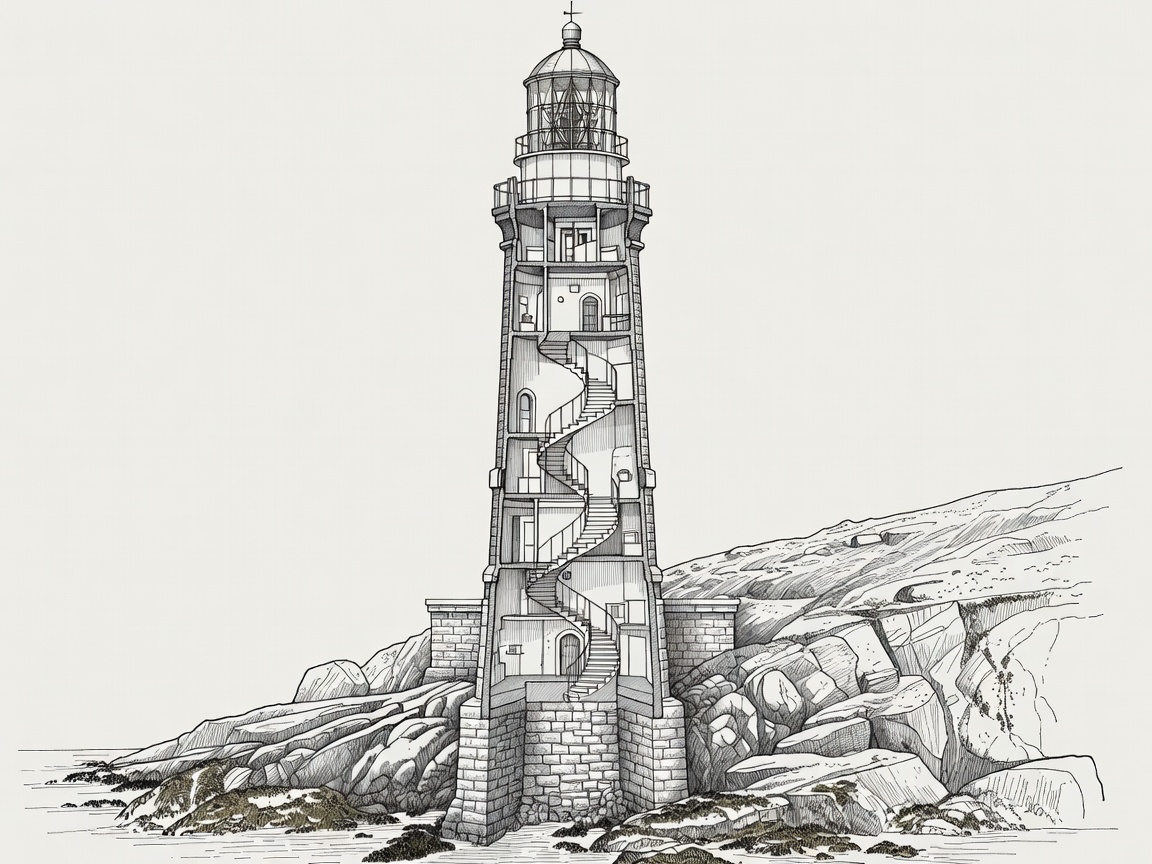
Why did Eddystone demand several different towers?
The reef offered little dry working area and took direct Atlantic swell. A lighthouse there had to be conspicuous enough for navigation, narrow enough to reduce wave load and strongly attached to rock that could not be treated as a broad, level building plot. Access depended on sea state. Materials, workers and tools arrived by boat. Work at the lowest courses had to fit the brief periods when the rock was exposed.
The early designers also worked before modern structural analysis, reinforced concrete and powered lifting plant. They relied on geometry, workmanship and lessons taken from marine construction. Each replacement exposed another weakness: combustible materials, excessive upper resistance to wind and waves, vulnerable joints, or deterioration in the supporting reef.
What changed between the early timber towers?
Henry Winstanley’s first lighthouse used an elaborate timber form fixed to the rock. It was enlarged after damage. The resulting structure presented a substantial profile to the sea. It was ultimately destroyed in a storm. The event made one point brutally clear. Height and visible complexity were useless if the entire assembly could not remain attached to the reef.
John Rudyard’s replacement was also largely timber, but its form was simpler and more tapered. A timber shell could flex and absorb some movement. It was also lighter than a comparable masonry tower. The trade-off was fire. The lantern became the source of a blaze that destroyed the structure. Two hazards now sat on the drawing board: external wave force and internal combustion.
How did John Smeaton make masonry work on a small reef?
Smeaton treated the tower as a bonded mass rather than a stack of ordinary blocks. The lower stones were dovetailed into one another and into prepared beds in the rock. Vertical and horizontal joints resisted movement in several directions. Courses narrowed as the tower rose. The external curve broadened towards the base and reduced higher up, often compared with the trunk of an oak.
Hydraulic lime was central. Unlike common air lime, it could set in damp conditions. Smeaton investigated lime containing clay and developed a mortar appropriate to exposed marine work. The tower demonstrated how material chemistry and stone geometry could reinforce each other. Mortar closed and distributed load across joints. Interlocking blocks prevented a simple sliding path.
Smeaton’s tower survived, but the rock below it deteriorated. Its upper portion was later removed and reconstructed on Plymouth Hoe as Smeaton’s Tower. The surviving stump remains on the reef beside the later lighthouse. This distinction matters. The masonry solution was durable; concern centred on its foundation rock and the need for a new position.
Why did James Douglass build a larger granite tower nearby?
Douglass, working for Trinity House, selected another part of the reef and designed a tower with a broader base and massive granite courses. The masonry again used interlocking forms. The base was made solid, while accommodation and service spaces occupied the rising shaft. Weight kept the structure seated. Curvature encouraged water to climb and break around the surface rather than strike a broad vertical wall.
Compared with Smeaton’s tower, the later structure belonged to a more mature lighthouse service. Quarrying, stone dressing, lifting and optical provision could be organised on a larger scale. Yet the governing logic remained recognisable: prepare sound rock, exclude weak continuous joints, keep the lower body solid and avoid unnecessary projections where waves can take hold.
How did the signal change when the structure became secure?
Early lighthouse illumination depended on flames and reflectors. The development of Fresnel optics allowed a lens to collect light through concentric prisms rather than a thick solid body. Rotating lens panels created a characteristic flash. Mariners could identify Eddystone by timing the observed sequence and checking the official light list, rather than relying on brightness alone.
Later electric equipment reduced fuel handling. Automation removed resident keepers from routine operation. Remote monitoring, duplicated equipment and planned maintenance took over tasks once performed continuously on site. Automation did not make the reef benign. It changed exposure for staff and altered the station’s internal arrangement.
Trinity House maintains general lighthouse authority responsibilities for England and Wales. Its published light lists and Notices to Mariners are the correct sources for operational characteristics. Those details can change. The stone record changes slowly. Four towers remain the sharper lesson: design advances when failures are read precisely.