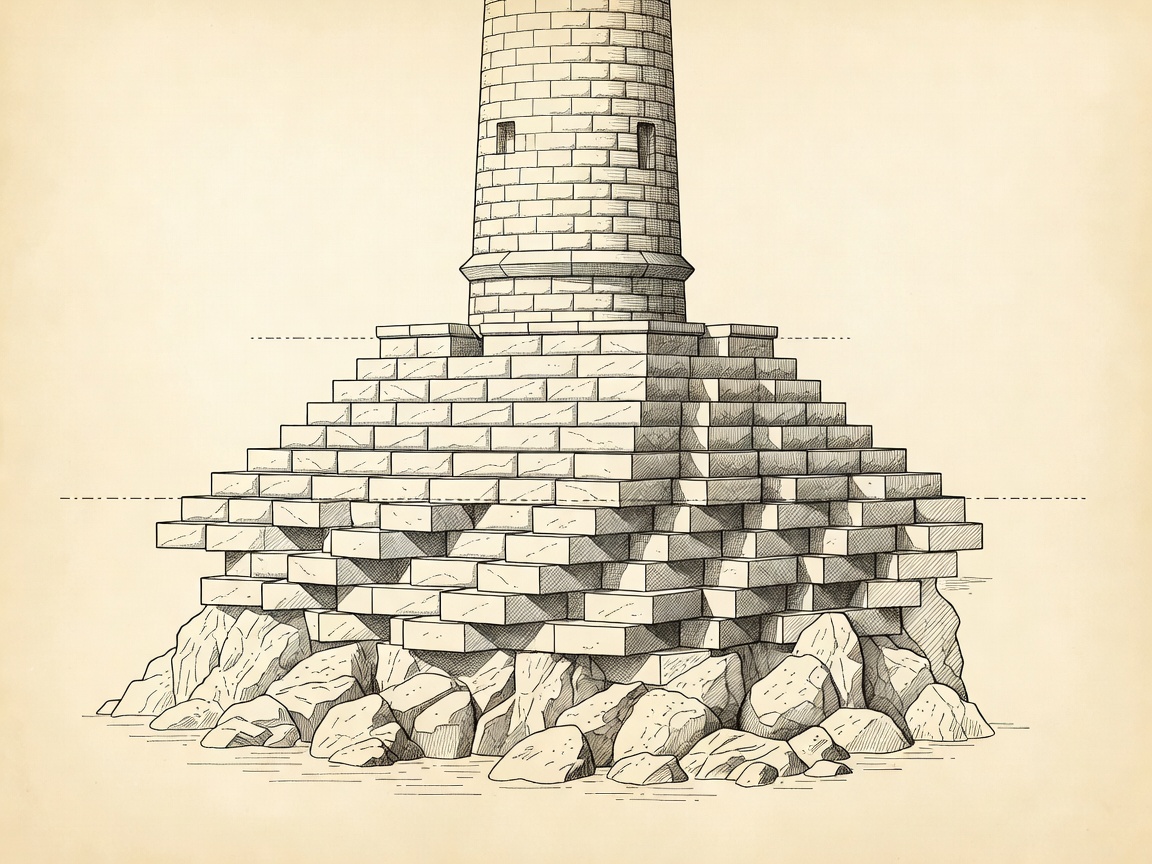
What made Bell Rock more than an ordinary offshore foundation?
The usable surface vanished beneath the tide. Workers could not establish a conventional camp beside the structure and continue through a full shift. Boats approached over water that could turn dangerous. At low tide, the rock emerged as a temporary yard. Soon the sea returned and covered tools, cuttings and unfinished beds unless everything was secured.
The reef’s position also made a reliable mark important to navigation in the Firth of Tay approaches. Earlier warning devices could not provide the reach and dependable identification of a permanent light. The requirement was clear. The method was not. Construction had to begin before safe shelter existed, then use each completed part to make the next part possible.
How was a permanent tower built from such short visits?
Robert Stevenson organised the project around shore preparation and offshore assembly. Stones could be selected, cut and marked on land. At the reef, masons concentrated on final fitting. A temporary beacon house raised on timber legs provided refuge above the rock and reduced dependence on returning to boats at every tide. The arrangement was vulnerable during its early stages, but it transformed the site once usable.
A stone-built work yard developed as courses rose. Moorings, boats, lifting gear and the shore establishment formed one construction system. The lighthouse cannot be understood from the finished tower alone. Its geometry was feasible because material control occurred elsewhere. Each numbered stone had a destination. Delays in transport or an inaccurate bed could consume an entire low-water interval.
John Rennie advised the Northern Lighthouse Board as engineer, while Stevenson directed the detailed execution and site work. Accounts of authorship should preserve both roles rather than compress a complex commission into a single name.
Why does Bell Rock have a solid lower body?
Open rooms low in the tower would create weaker walls and places where water pressure could act internally. Solid masonry adds dead weight and keeps the most exposed portion compact. The base curves outwards into the reef. Above the main impact zone, the shaft narrows and usable rooms become practical.
The stones were dovetailed and joggled so that adjacent units resisted separation. Courses were connected as well as individually bedded. This continued a principle demonstrated at Eddystone: a wave should meet a coherent mass, not independent blocks held only by gravity and mortar. Granite and sandstone were used according to structural position and supply. Accurate dressing mattered because broad, close contact spreads compression and limits water entry.
- Primary load
- Breaking water acting horizontally and upwards on the low courses.
- Primary defence
- Mass, curved profile, keyed stone and direct connection to prepared rock.
How did the optical system develop after the tower was complete?
The original apparatus used oil lamps and reflectors. Parabolic reflectors collect light from a flame near their focus and send it outward as a beam. Several units could rotate together, producing alternating periods of light and darkness. Mechanical clockwork drove rotation and required regular winding.
Fresnel lenses later provided a more efficient route. Their stepped rings perform the bending action of a much thicker lens with less material. A rotating optic can form flashes whose rhythm distinguishes one station from another. Changes in fuel, lamps and electrical supply improved control, but the characteristic remained an operational identifier rather than decoration.
Automation replaced continuous keeper attendance with monitored equipment and scheduled maintenance. Redundancy became especially important. A fault no longer met an immediate human response from the next room. Alarm systems, standby components and visiting technicians became part of the design.
How does Bell Rock compare with Skerryvore and Eddystone?
All three use a broad, solid base and tapering masonry shaft. Eddystone supplied a precedent for interlocking stone. Bell Rock pushed the method into a tidal construction problem of exceptional severity. Skerryvore then applied related reasoning to a low Atlantic skerry with different stone supply and wave exposure.
Bell Rock’s special lesson lies in sequencing. Foundation work, refuge, landing, lifting and masonry were not separate topics. Each enabled the next. The finished tower appears singular and calm. Its construction was a chain of temporary systems arranged so none had to bear more risk than its stage permitted.
The Northern Lighthouse Board is the general lighthouse authority for Scotland and the Isle of Man. It publishes navigational information and manages aids to navigation. Operational details should be checked against its official notices and light information. The structural principle remains fixed in stone: when the sea repeatedly removes the workplace, logistics become part of the foundation.