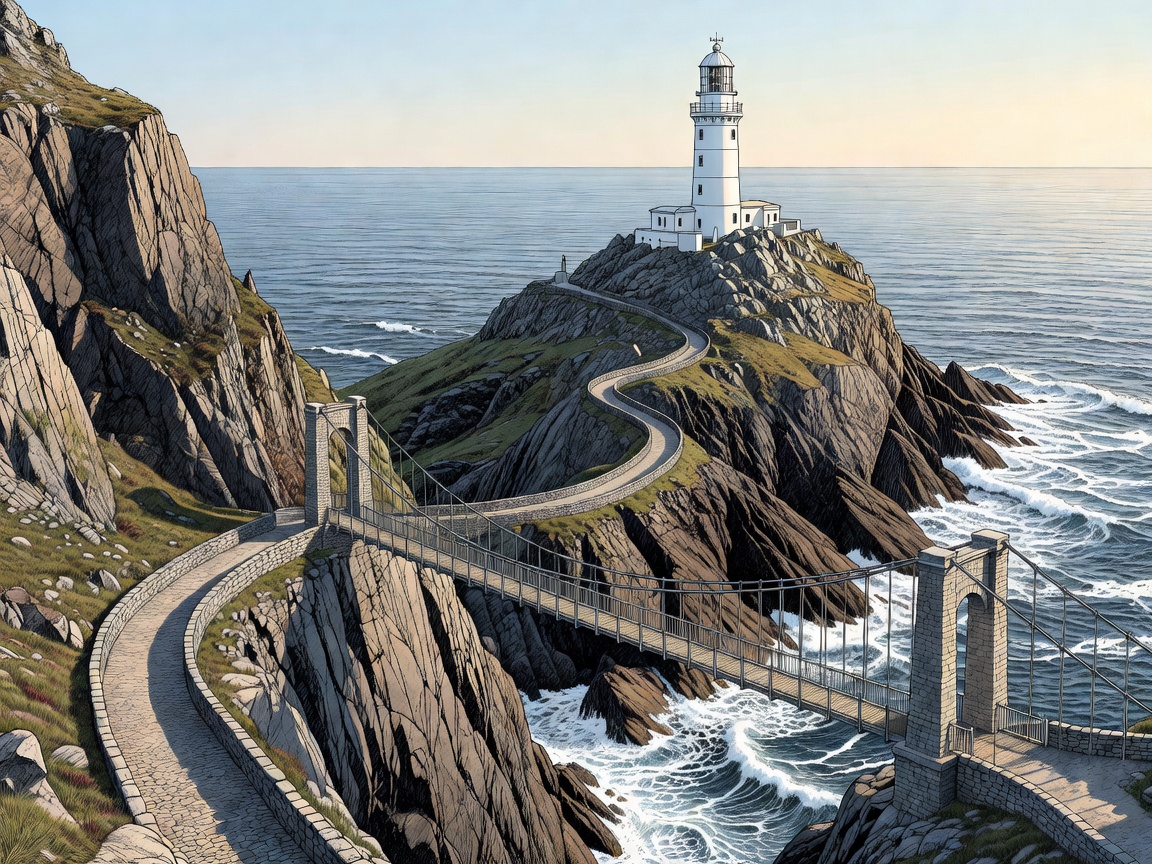
Why place a lighthouse below the towering cliffs of Holy Island?
A navigational light must serve the approaches seen from the water, not simply occupy the highest ground. South Stack’s island position puts the signal close to the coastal hazard and gives it a useful relationship to routes around Anglesey. The cliff behind remains prominent, but the station itself defines the offshore edge.
The site differs sharply from Eddystone, Bell Rock, Skerryvore and Fastnet. Those towers rise directly from low wave-washed rock and depend on massive lower masonry. South Stack has a larger island platform. Buildings can spread around the tower. The engineering difficulty moves from foundation mass towards access, exposure and the reliable operation of a small compound.
Does South Stack need the same monolithic form as an offshore rock lighthouse?
No. Its tower stands on a more substantial rock base and does not receive the same continuous overtopping action as a shaft planted on a low reef. It can therefore use conventional masonry walls around internal spaces rather than a deep solid plinth of interlocked granite. The tapering circular form still performs familiar work. It resists wind from any direction, avoids vulnerable corners and supports the lantern at a useful elevation.
The surrounding keepers’ buildings form part of the station. Stores, accommodation and service spaces need not all fit inside the tower. This lowers pressure on the tower plan and permits easier maintenance. It also creates more roofs, doors and drainage details exposed to salt-laden air. A dispersed station exchanges extreme structural concentration for a larger maintenance envelope.
- Foundation setting
- Rock island with more usable area than a tidal reef.
- Design emphasis
- Lantern elevation, access, weatherproofing and compound operation.
How does the access route shape the station?
The mainland approach descends the cliff by a long flight of steps. A bridge crosses the channel to the island. Before a permanent bridge connection, transfer arrangements were more dependent on sea and weather. The bridge does not make the site ordinary. It concentrates access into a single exposed link that requires inspection and control.
For keepers, every supply had to descend, cross and reach storage. For maintenance teams, tools and replacement parts follow the same constrained route. Emergency planning must consider the cliff path, channel and sea together. Visitors add another requirement: public access must be separated from operational areas and restricted when conditions make the route unsuitable.
Compared with Fastnet, a South Stack visit can begin from land. Compared with a mainland tower beside a road, it remains laborious. The middle condition matters. It explains why automation delivers a large reduction in routine staffing while the physical station can still support planned access.
How do lens and fog signals address different visibility problems?
The optical light works when the lantern can be seen. A concentrated beam, formed by a Fresnel lens or later optical arrangement, travels towards the horizon. Rotation or programmed operation creates the station’s identifying characteristic. Coloured sectors may warn of particular directions where required by the navigational scheme.
Fog removes visual range. Sound signals historically supplied another channel, though sound behaves unpredictably over water and around cliffs. Wind direction, temperature layers and the landform can affect where a signal is heard. A fog signal therefore supplements navigation. It does not provide the directional precision of a charted light bearing.
Mariners should use Trinity House publications and current Notices to Mariners for operational details. Characteristics and equipment can be altered. The enduring technical point is that every signal has limits. Safe navigation combines chart, position, lookout, electronic aids and official information.
What does automation remove, and what remains?
Automation removes the need for keepers to attend the station continuously. Automatic lamp control, power management, alarms and remote communications handle routine functions. Trinity House can plan maintenance around equipment condition and access rather than maintain a permanent household solely to tend the light.
Human work remains. Lantern glazing needs inspection. Corrosion must be treated. Batteries, electrical equipment and mechanical components require replacement. The bridge, steps, roofs and masonry continue to weather. Automation reduces repeated attendance. It does not turn a maritime structure into a sealed appliance.
South Stack also shows how lighthouse meaning can separate from lighthouse operation. The station remains a strong coastal landmark and a place of public interest, while its navigational work proceeds through compact automated systems. The dramatic setting is constant. The operating method is technical, monitored and comparatively quiet.
Within the five-site sequence, South Stack closes the argument. Not every lighthouse needs a heroic offshore foundation. Design follows the actual hazard. Here the central lines are cliff, bridge, compound, tower and beam.