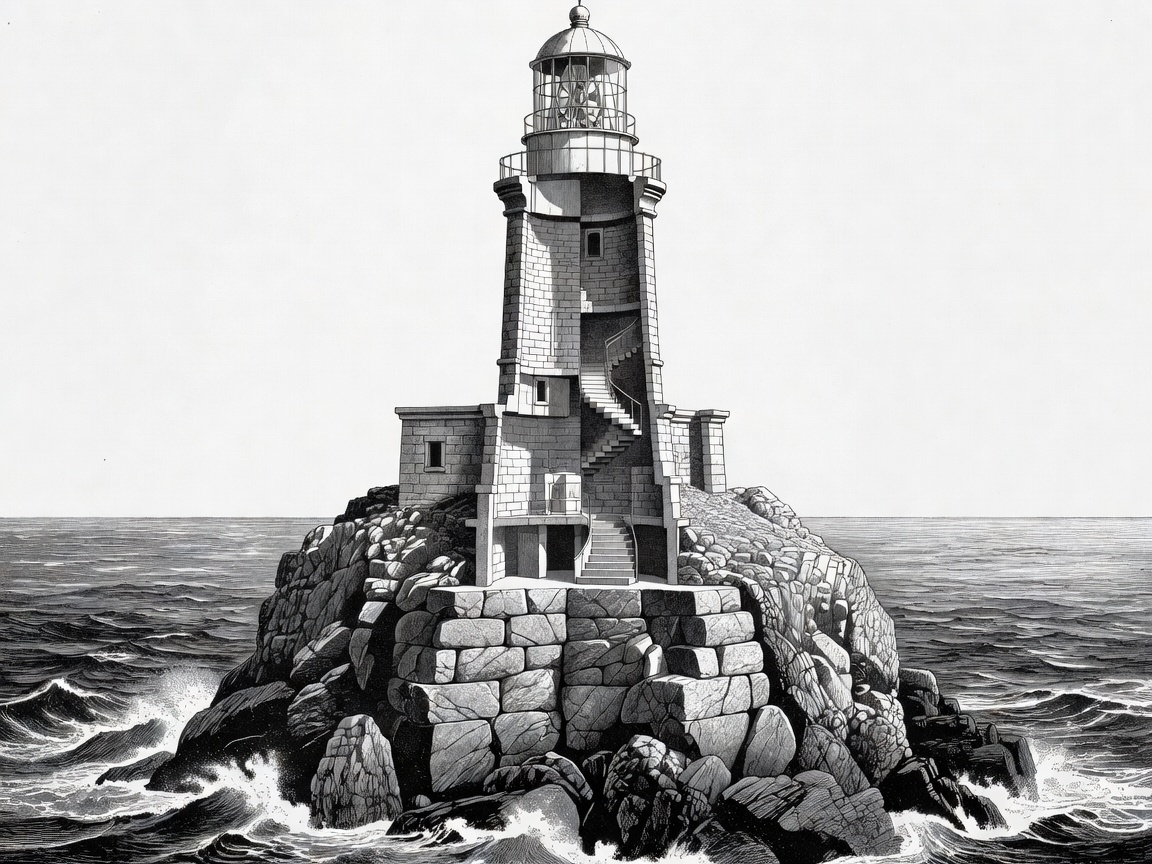
Why was the earlier Fastnet tower replaced?
The first lighthouse on the rock used a cast-iron structure with an internal lining. Iron offered prefabrication and relatively quick assembly. On a remote rock, those were serious advantages. Yet a tall metal tower can flex under wind and wave loading. Connections, internal finishes and optical alignment all feel that movement. Concern over strength and long-term behaviour led to a new masonry solution.
The decision was not a verdict that iron had no place in lighthouse engineering. Metal towers suited many locations, especially where low mass or modular assembly mattered. Fastnet imposed a different test. Its steep rock, ocean exposure and importance as a landfall light favoured a heavy monolithic form with a long service horizon.
How did William Douglass adapt the masonry lighthouse tradition?
Douglass had already designed the later Eddystone lighthouse for Trinity House. At Fastnet, he again used carefully shaped granite blocks, interlocking joints and a curved tower profile. The rock did not offer a flat circular base waiting to be occupied. Foundation beds had to be cut into the natural surface. Lower courses followed the available sound rock before the masonry resolved into the regular shaft above.
The base acts as an extension of the rock. Blocks are not merely placed on top. They are keyed into prepared steps and bonded to neighbouring stones. The lower mass remains solid. Internal rooms begin higher, where the reduced wave load makes voids less structurally costly. The tower narrows towards the lantern, reducing exposed area and upper weight.
Granite brings high compressive strength and resistance to weathering. It also demands exact quarrying and dressing. An uneven contact face concentrates load at a few points. A close bed allows the course to carry compression as intended.
Who turned the drawings into work on the rock?
James Kavanagh supervised construction for the Commissioners of Irish Lights. That role involved more than checking finished masonry. Offshore work depended on boats, lifting gear, moorings, weather judgement, stone identification and communication with the shore base. Each prepared block represented labour already invested before it reached Fastnet.
The low courses were especially slow. Beds had to be cut accurately into irregular rock while working close to breaking water. As the structure rose, it created a more dependable platform and storage area. Progress changed the worksite itself. A partially completed tower supplied shelter and lifting positions unavailable at the start.
Douglass died before the work was complete. Kavanagh carried the construction through. The finished lighthouse should therefore be read through both design authorship and site execution. Remote marine structures make that distinction visible. A drawing specifies geometry. The resident engineering organisation finds a safe sequence for making it real.
Why is Fastnet’s light characteristic as important as the tower?
A mariner may see more than one light. Position alone may not settle which one is being observed, particularly before a precise bearing is established. A characteristic supplies identity through colour and timing. Rotating optics create periods of illumination and eclipse. Sector lights can mark different arcs where local hazards require them.
A Fresnel lens gathers rays from the source and redirects them towards the horizon. Its annular form reduces thickness and weight compared with a conventional lens of similar aperture. At a major station, the optic, lamp, rotation mechanism and lantern glazing operate as a single instrument. Soot in an older lamp, a rough bearing or salt on glass could reduce the useful beam.
Electrical lighting simplified control and permitted automatic changeover. Modernised equipment reduced the burden of fuel handling. None of this made optical maintenance trivial. Alignment, cleanliness, power and monitoring remain linked.