Why did Skerryvore need a tower of exceptional mass?
The reef offers little height above the surrounding water. Waves can cross it rather than merely break at its edge. A tower therefore receives impact low down, spray and water higher up, and vibration through the rock beneath. The useful foundation area is constrained by the skerry’s shape and soundness. Enlarging the footprint indefinitely is not an option.
Alan Stevenson, engineer to the Northern Lighthouse Board, had the Bell Rock precedent within his own family’s engineering tradition. Skerryvore was not a copy. Its location, available stone and exposure required a fresh balance between diameter, height, curvature and internal space. The finished form reads as simple because the difficult choices have been absorbed into its section.
What does the tower’s curve actually do?
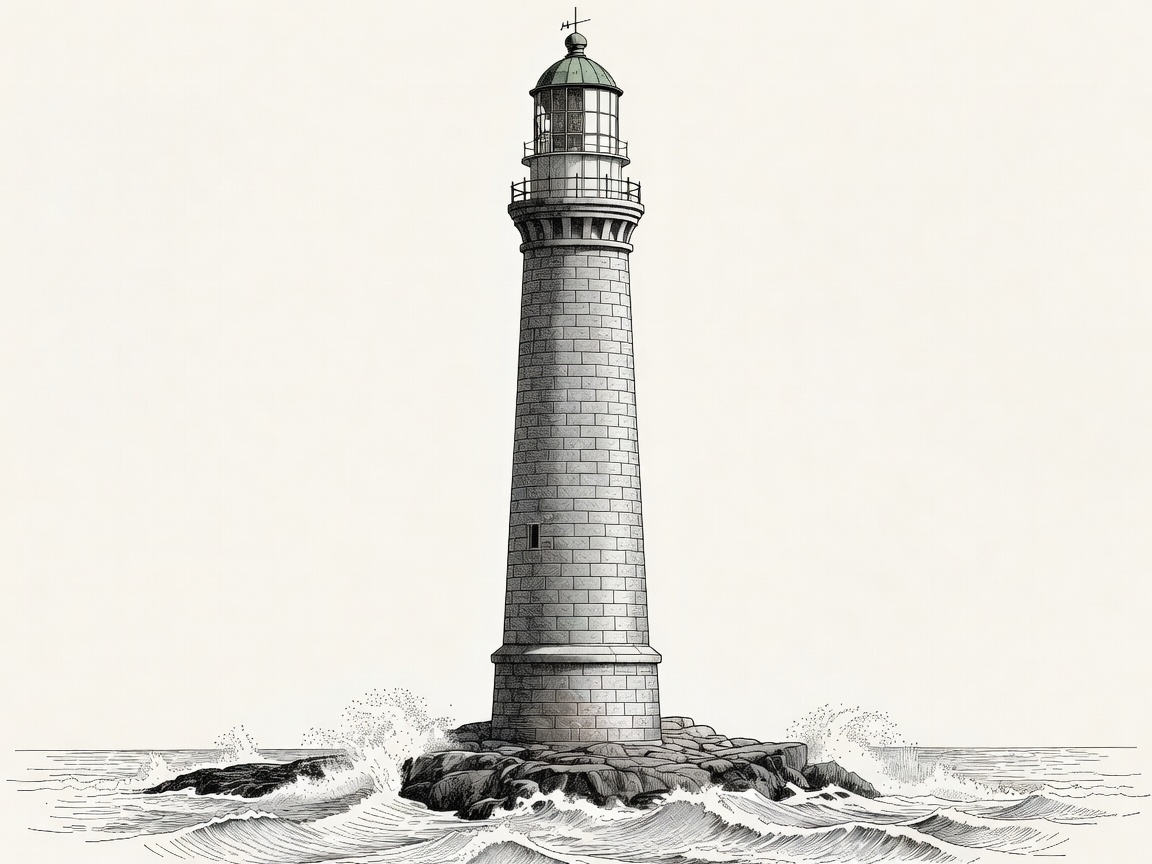
The broad foot supplies weight and spreads compression over the prepared reef. The shaft then tapers. Less area faces wind and breaking water as it rises. A smooth surface avoids ledges where force can concentrate. The curve also keeps the centre of mass low while allowing rooms in the upper portion.
The lower tower is solid. Courses of carefully fitted masonry behave as a connected body. Above that mass sit storage and accommodation spaces, then service rooms and the lantern. This vertical ordering follows exposure. Empty volume is placed where external loads are lower. Heavy material remains where sliding and overturning resistance matter most.
Individual stones were cut to bond within their courses. Vertical joints did not align into convenient fracture planes. The tower’s security depends on the whole arrangement: dead weight, friction, joint geometry, mortar and curvature. Remove one line from that calculation and the others must work harder.
How did material choice shape the construction plan?
Granite resists compression, abrasion and marine weathering, but it is hard to quarry and dress. Blocks must be shaped accurately enough to spread load across their beds. Every correction made offshore consumes scarce working time. Stevenson’s organisation therefore relied on preparation away from the reef, transport by vessel and a shore establishment able to manage stone before shipment.
A temporary barrack on the rock was attempted, echoing the staged shelter used at Bell Rock. Storm damage showed the danger of trusting a light structure in an exposed position. Accommodation and operations had to be reconsidered. The incident did not change the need for a permanent tower. It sharpened the distinction between a temporary structure that must survive construction and a final masonry mass intended for long service.
How does the lantern turn light into an identity?
A lighthouse does not communicate by brightness alone. Its characteristic is the pattern of flashes and eclipses observed over time. Lens panels group light into beams. As the optic rotates, those beams sweep past an observer. The spacing of panels and rotational speed establish the visible sequence.
Fresnel optics suit this task because concentric prism sections redirect rays while avoiding the weight of a full-thickness lens. Central bands handle light near the horizontal plane. Upper and lower prisms recover rays that would otherwise escape. The apparatus must remain accurately centred around the lamp. Bearings and drive machinery need controlled movement. Salt, condensation and temperature changes all become maintenance concerns.
The official Northern Lighthouse Board light information is the source for navigational use. A published chart or light list provides the characteristic, colour and sector information needed at sea. A historical account can explain the mechanism. It should not replace an operational publication.
What changed when keepers no longer lived at Skerryvore?
Automation shifted the station from continuous local supervision to remote indication and periodic visits. Lamps became easier to start and control. Electrical systems allowed automatic changeover. Sensors could report faults. Reliable communications became as important as a store of fuel had once been.
The architecture also changed in use. Keeper accommodation ceased to be the centre of daily operation. Space could support batteries, controls and maintenance access. Landing remained a serious marine task, so fewer routine visits reduced exposure without removing it. Technicians still require safe procedures, suitable vessels and acceptable conditions.
Against Bell Rock, Skerryvore looks taller and more isolated in open water. Against Fastnet, it shares the logic of a granite monolith on a low rock. Its particular clarity comes from its profile. The shaft seems almost abstract. Under that clean line sits a dense record of quarrying, transport, tidal work and exact jointing.